We explain what to expect throughout the renting process with ludlowthompson.
From how to find a property to rent, reserve it, agreements and moving in.
Finding a property
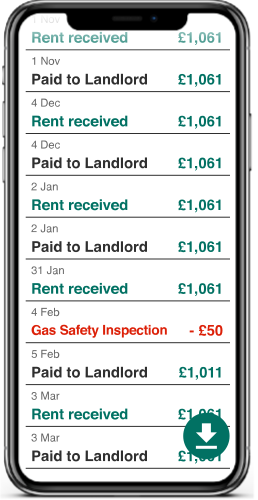
To make it easier for you to find a property to rent, we offer some very useful and free services via our website. From our quick search facility to our handy journey planner on all property details, we take the hassle out of finding a property to rent. You won’t need to revisit the website because we do the hard work for you by keeping you alerted to new property with Email & Text Property Alerts; you can even view all property details on our website via your mobile phone with ludlow.mobi. Once you find a property to rent, we guide you through every step of the way with our ‘My Account’ facility containing everything you need during the tenancy from all your documents and a link to report repairs (only where the property is ‘Managed’ by ludlowthompson).
Reserving a property
When you wish to secure a property to rent with us, we will require a reservation fee of £500. This is to guarantee (subject to satisfactory references) that the property is secured for you whilst we draw up agreements. We will ensure that the reservation fee is deducted from your total deposit. There is an administration charge of £500 if you cancel. In any circumstances where the fee is refundable we will send you a cheque within 10 working days.
Providing reference details for renting
Before we can draw up the Tenancy agreement we will need to take references including a credit check. We have to satisfy the landlord that you are able to pay the rent and have a good character reference. You will be able to complete the reference online via our website link; once you have signed up we will email you the details. Once you start the reference process all information needs to be completed within 24 hours.
You will need the following reference details for renting:
- Full name, date of birth, nationality
- Your address history for the last 3 years
- Proof of address: bank, credit card or mobile phone statement
- Income/occupation: details of your income sources and employer
- Bank account: details of the bank account to be used to pay the rent
- Credit/debit card: details of the card and statement address
- Your next of kin: details of who to contact in an emergency on your behalf
- Name of previous landlord/managing agent (if any)
- Contact details of someone who can provide a character reference for you
- If you’re a student you will need to provide proof of your student status
About Guarantors
In some circumstances we will ask for a Guarantor to underwrite the rent. Typically this is the case when the tenant is a student, is self-employed or has only been employed for a short while. A Guarantor has to be a homeowner, have a clean credit history, and be in employment or in receipt of pensions. Your contact at ludlowthompson will explain more if necessary and make the appropriate arrangements.
Guidance for overseas tenants
Many people from overseas successfully find a property to rent with ludlowthompson. Simply complete as much of the reference detail as possible and we will process your application.
We appreciate that you may wish to discuss or read about renting in your own language.
Many of our staff are multi-lingual so just ask us if you wish to speak in your own language.
We have translated the details we require for references into selected languages, which will be given to you when you start the reference process.
You may find it helpful to translate these website pages into your own language by clicking on our flag links at this website or using Google’s free translation service at www.google.com/language_tools
Deposits, fees and rental payments
Deposit with the first rental payment
We take 6-8 week's worth of rent as deposit along with your first month’s rental payment. In addition we charge an administration fee of either £250 + VAT or one week’s rent + VAT, whichever is the greater. As complies with the law, your deposit is safeguarded by an independent rental deposit scheme called Tenancy Deposit Solutions http://www.mydeposits.co.uk/tenants/how.aspx
How to pay the rent
- By Standing Order (our preferred method)
Standing Order dates must be set up for a minimum of 3 days before the rent due date stated in the tenancy agreement. This will allow time for the monies to be first transferred into the ludlowthompson Client Account and then into the Landlord's account.
- By telephone:
Between 9am and 5pm Monday to Friday. Call 0871 288 1744
- By cheque:
Cheque payments must be sent or delivered to: ludlowthompson, Property Management Office, 12 Clapham Road, London, SW9 OJG. We must receive the cheque at least 7 working days before the rental due date stated on your tenancy.
We regret that we cannot accept cheques for rent payments at your local ludlowthompson Office. Rental can only be accepted in the name of the tenants named on the Tenancy Agreement. Where cheques are posted, ludlowthompson cannot issue receipts.
The Letting Agreement Between Landlord & Tenant
You will be provided with a copy of the contract you sign known as the Tenancy Agreement. Both the tenant and the Landlord are required to sign the Tenancy Agreement. This will form your letting contract. The agreement normally used is called an Assured Shorthold Tenancy. This entitles the Landlord to possession of the property at the end of the tenancy period. Most rental tenancies are for 12, 18 or 24 months.
Where the Landlord has instructed or accepted a break-clause, this normally provides, under Clause 10 of the Tenancy Agreement, a right for either the Landlord and/or the Tenant to terminate the Agreement after a shorter period, typically 6 month less that the tenancy term - but with 2 months notice period (so 4 months less occupation that the full term in total). This notice has to be served in writing by the party giving notice. Any special requirements, such an extra item the landlord agrees to supply e.g. a bed, or variations to the standard tenancy agreement will be listed in a Rider document and attached to the Tenancy agreement. You should note that the Landlord does not have an obligation to carry out pre-contact promises of furnishings or repairs for renting unless they have been listed on the Rider attached to the Tenancy Agreement. This does not apply to items which are required by statute or properly arise after occupation.
Your contact at ludlowthompson will go through the Tenancy Agreement with you, and provide you with a copy signed by all parties. Generally the points you should note under the Tenancy Agreement are:
- The Tenancy Agreement is between you and the Landlord. ludlowthompson are not a party to the Contract and are not appointed to arbitrate its terms.
- All Tenants have joint and several liability under the Tenancy agreement.
- You are contracted to stay in the property for the duration stated in the Tenancy Agreement. The Assured Shorthold Tenancy agreement means that the Landlord has already served formal Notice to you to give up possession on the date stated in the Tenancy Agreement.
- Where a Guarantor has entered into an Agreement, in the event of the Tenant not meeting the obligations under the Agreement, the Guarantor would be liable to accept responsibility.
Arranging utilities
The arrangement in almost all cases is that the Tenant has to pay gas, electricity, telephone, water and local authority council tax. You should liaise with the Landlord to the obtain details needed to change services into your name. Electricity and telephone services must be applied for at least 4 working days before moving.
Provision of keys
We ask the Landlord to provide a set of keys for each tenant renting the property. Under no circumstances are locks to be changed by the Tenant without prior approval of the Landlord. Tenants must ensure they return all keys to ludlowthompson at the end of the tenancy period, otherwise monies will from the rental deposit money will be kept to pay for replacing any locks.
ludlowthompson sometimes retains a set of keys which may in emergencies be borrowed by the Tenant. A satisfactory means of identification must be shown before keys will be handed over. A minimum deposit of £20 will be required before we can lend you any keys. Where Banham or security keys are involved this deposit will be appropriately increased. We stress that Tenants should return borrowed keys as quickly as possible.
Moving into the rented property
Your contact at ludlowthompson will arrange to for your ‘Check-In’ to the property you are renting. At this stage a report, (an inventory or Check-In Report) will be prepared to record the condition of the property. We ask you to sign this report to clarify that the condition of the property is as recorded. We ask the Landlord to ensure that the property is clean and tidy prior to you moving in. We also ask the Landlord to leave you any instruction or appliance manuals in a binder for your reference. And, if the property is ‘Managed’ by ludlowthompson, we will send you a Tenant’s Information Pack detailing your contact details during the tenancy.
About inventory and check-in reports
If a Landlord does not arrange an inventory we prepare a report called a Check-In Report. It is important that you check you are agree with the Inventory or Check-In report as it will be used to check the condition of the property at the end of the tenancy. Your Landlord will compare the Inventory or Check-In report against the outgoing report to determine if deductions for repairs should be taken from your rental deposit. The report will record the condition of the contents such as small household appliances, crockery etc, plus the general interior and large household appliances e.g. the fridge. A Check-In records the general condition of each room (the walls, appliances, curtains, lighting etc) which will be compared against a report done at check out stage.
Your safety under gas, furnishing and electrical regulations
The Landlord is obliged to make arrangements to ensure that the property is safe for you whilst renting under gas appliances, furnishings and electrical regulations.
The Gas Safety (Installation and Use) Regulations 1998:
All gas appliances and associated pipe work must by law be maintained in a safe condition and be checked for safety at least every 12 months by a suitably qualified engineer. Before moving into the property, you must be handed a copy of the last record of inspection. Also, a record of these checks should be in the property. Similarly, instructions for these appliances should be in the property. If you feel that these conditions are not being complied with tell your Landlord immediately.
The Furniture and Furnishings (Fire) (Safety) Regulations:
Amongst other matters this Act requires that all furniture must have a label clearly showing that it is fire resistant. Any new or additional furniture being put into the property must also comply with these regulations.
The Electrical Equipment (Safety) Regulations 1994:
Electrical appliances must be checked before you move in to the property. Safety regulations fact sheets can be viewed at http://www.letlink.co.uk/letting-factsheets/factsheets/
Contact During the Tenancy
Unless your rented property is ‘Managed’ by ludlowthompson you will deal directly with the landlord after you move in. Your property consultant at ludlowthompson will be able to advise you on this point.
If you have any queries (‘Managed’ property only):
Once you have moved in to the property, we will email you a Tenant Information Pack, the contents of which are listed below, and this information will also be available online during your tenancy through the “My Account” section on our website.
From the date of your occupation all correspondence should be dealt with by your Property Manager at ludlowthompson, whose contact details will be detailed in your Tenant's Information Pack.
Please note that in the interest of all parties concerned, ludlowthompson will only correspond or discuss any matters with the parties who are renting as named in the Tenancy Agreement. However, if any party wishes to nominate another to handle their affairs, they can provide a legal Power of Attorney document for that party and from then on, ludlowthompson will only deal with this party in substitution of the original.
Contents of Tenants' Information Pack for renting:
- Contact numbers you'll need for ludlowthompson (e.g. your Property Manager)
- Copy of the signed Tenancy Agreement
- Property Inventory or Check-In Report
- Gas safety check (if applicable)
- Spare standing order forms
- Any service contracts relating to property
- Particular requirements relating to the property
- Guidance notes issued to tenants: how to deal with condensation, deposits, giving notice on your lease, inspections, keys, replacing Tenant information, reporting repairs, tenants information sheet
If you need repairs whilst renting (‘Managed’ property only)
You should report a repair to your Property Manager via our website under the ‘My Account’ link. Or you can write to your property manager whose contact details will be within your Tenant's Information Pack.
Normally we have authority from the Landlord to carry out repairs up to £250. However, some landlords insist we obtain their authority prior to arranging repairs. We appreciate that you want the property to be in working order and try to arrange repairs as soon as possible. Before we can go ahead we may have to gain a quote for the works from the contract repairer and then seek the Landlord’s approval.
Out of hours repairs for emergencies only
For emergency repairs that occur out of hours – 5pm to 9am - you need to phone a separate number. Once you become a tenant, you will find the telephone number on your tenancy agreement or within the ‘My Account’ section of this website.
Visual inspections (‘Managed’ property only)
During the course of the tenancy, every four months, we may inspect the premises you are renting to verify that the terms of the Tenancy Agreement are being complied with. We will write or telephone to you to make arrangements for an inspection date. Provisions for these arrangements are included in the Tenancy Agreement.
Renewing your tenancy or moving out
Two months before the end of the tenancy, we contact you to see if you would like to renew your tenancy. If you wish to stay on in the property we seek approval from the Landlord and make any necessary arrangements. If the Landlord does not wish to renew the tenancy we can start looking for an alternative property to rent if you wish. Please appreciate that if you are not staying in the property we may wish to show it to other prospective Tenants during your notice period.
Return of your rental deposit
At the commencement of the Tenancy you would normally have been checked in and an inventory or Check-In Report outlining the condition of the property. At the end of your Tenancy, a similar Check-out Report is compiled and this is where the condition and cleanliness of the property is checked and reported back to the Landlord. Normally this document is referred to by the Landlord in deciding what deductions for repairs, if any, need to be made from your deposit. ludlowthompson cannot be involved in any decision over return of deposit - this is between the Tenant and the Landlord. You can liaise with the Landlord about return of deposit, after the inventory or our Check-Out report has been done. A copy of this report will be sent to you for your reference.
Protection of deposits for tenants
Landlords are required by legislation to pay a tenant’s deposit into a separate custodial or insurance based Deposit Scheme. Either type of scheme will protect a tenant’s deposit money. If only part of the deposit is in dispute, then the remainder that is not in dispute must be returned to the tenant within a maximum of 10 days of the tenancy ending. The tenant and landlord can jointly or separately apply to the Deposit Scheme to have their case referred to Resolution or Court. Once a resolution has been reached, the deposit must be returned within a maximum of 10 days. Landlords who let their property through ludlowthompson use the Tenancy Deposit Solutions scheme - to find out more see http://www.mydeposits.co.uk/tenants/how.aspx
This information was correct at the time of publication and may be periodically updated. Advice may vary between agents so please check if you wish to clarify any points.
|